The Darwinian loop applied to algorithms and organisations. Without the bloodshed.

Most businesses inherit practices from their predecessors, you often hear phrases like “this is how we’ve always done it”. But most data lives in the past and the only thing that is guaranteed is change. From my experience, about 80% of small business problems can be solved by best practices: refined processes, better skills or the right tools. The remaining 20% is complex, so it usually gets pushed up the chain of command for answers.
Faced with the unrealistic expectation of answering the unknowable, leaders tend to guess, micro-manage or apply force. But other ways for decision making under uncertainty have existed for decades, one borrowed from biology and computer science.
While researching complex systems, I discovered genetic algorithms (GAs) as a strategic tool. An idealised computational model of Darwinian evolution, a GA breeds, scores and combines solutions iteratively towards a defined “fitness”. It’s a technique for solving novel problems, decentralising solution-seeking, and navigating uncertainty.
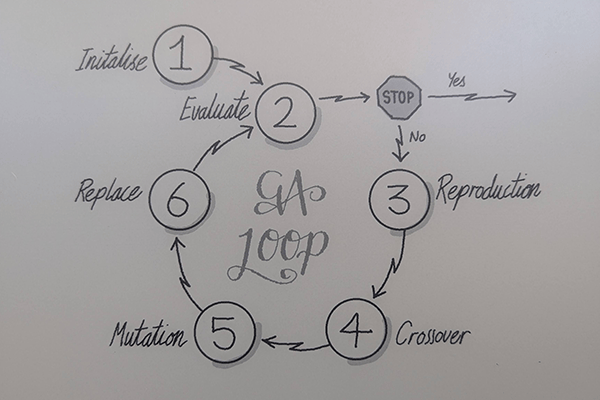
How it runs
- Initialise the population. Start with a randomly generated set of solution strings.
- Evaluate fitness. Rank individuals based on how well they achieve your desired outcome.
- Reproduction. Select the top-performing individuals to serve as parents.
- Crossover. Pair parents to produce offspring by swapping segments, combining traits into new children.
- Mutation. Randomly alter minor values in the offspring’s chromosome to maintain diversity.
- Replace and iterate. Fill the new population with these offspring and repeat the cycle from step 2.
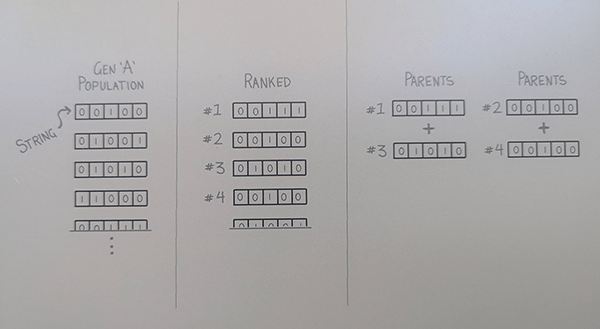
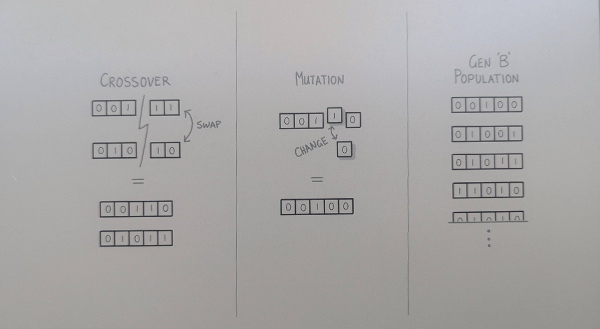
This loop is the tool. The selection criteria are centralised with the stored memory decentralised throughout the population.
A brief history
The history of GAs starts with the most famous biologist of all time and somehow arrives at recent AI development. Apparently everything works its way back to AI these days.

Charles Darwin published The Origin of Species in 1859. His thesis was that organisms compete for limited resources and adapt to their environment with the survivors reproducing at a higher rate. Offspring inherit recombined traits from their parents with some mutations, and the loop keeps running over millennia.
By the 1920s, mathematicians represented genetics in algorithms for population growth. John Holland formalised the method in his 1975 book Adaptation in Natural and Artificial Systems, exploring whether programs could be bred like corn crops. The 1990s saw genetic programming advance computer graphics and film animation.
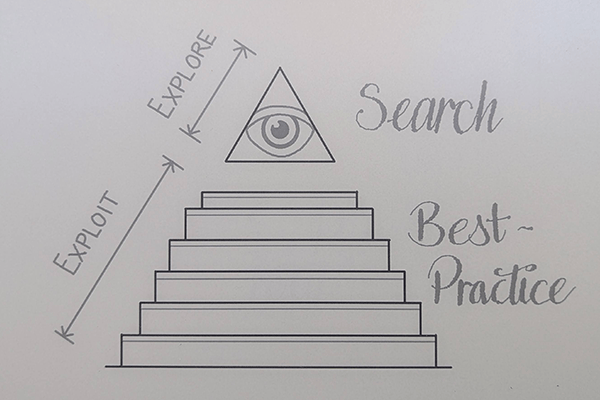
That brings us to AI. Modern LLMs excel at best-practice tasks but struggle with novel solutions in uncertain domains. Evolutionary computing now sits on top as a powerful search strategy. By using evolutionary methods, Google’s AlphaEvolve discovered novel mathematical algorithms while ShinkaEvolve achieved similar performance with far fewer queries.
The benefits of GAs
Action under complexity
In complex systems, optimal solutions are often unfindable. GAs provide a procedure for action rather than false certainty. They prioritise engagement with reality and iterative learning over exhaustive analysis.
Minimise the risk of ruin
Experiments across randomised environments lower the chance that a single scenario skews results. Bad strategies are eliminated early, as avoiding ruin is central to survival. In “survival of the fittest”: fitness serves survival, not vice versa.
Solutions from outside the human box
GAs offer non-conventional thinking complementary to human design, often producing ingenious hacks that surprise experts. NASA described using GAs for antenna design as “exploring the dark corners of the design space.”
The Limitations
After their initial popularity, scientific critique identified specific limits in GAs. Even the populariser of the method, John Holland, challenged their performance in certain domains.
False Peaks & Hitchhiking
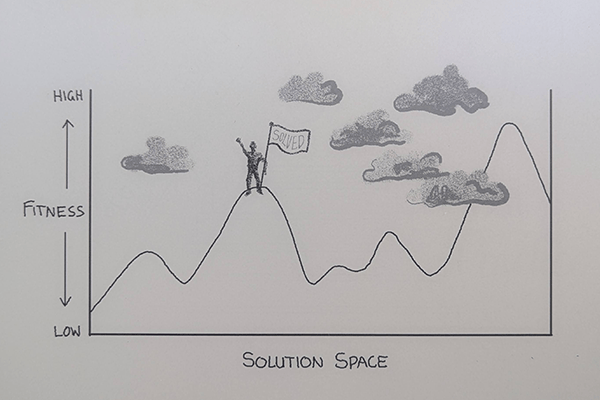
GAs can prematurely converge on “local maximums” or false peaks. It’s being confident you are at the highest fitness point, when you’re actually not. They also suffer from what’s called “hitchhiking”, where sub-optimal traits spread by clinging to successful ones. I find this funny. It’s like a lazy student choosing smarter peers to do a project with. Clever in a different way.
Cost of exploration
The resources required to run each generation are real. Processing power, money, or time can make deploying GAs impractical. In some cases, simpler search methods solve problems ten times faster.
Getting fit for the wrong sport
Designers must carefully define the environment and fitness function. “Fitness” is a subjective term with potential unintended consequences. Solutions are only optimal relative to these exact, often simplistic, parameters.
Feedback loop delays
Robust solutions require multiple generations. While computers handle this instantly, real-world feedback loops (like 30-year human generations) can be too slow for business timeframes.
From Algorithms to Organisations
A quick thought experiment on applying GAs to business. Think of a local restaurant menu as an evolving code. Failed dishes are cut, successful ones stay, and tweaks happen based on customer feedback. Between competing restaurants you see the new ones copy the popular ones, then adapt the menu to the local demographic. I believe this process matters just as much as who survives.
Each new restaurant that opens holds the lessons of the failed and successful, encoded inside its menu.
If restaurants do this naturally through market survival, how can an SME do this intentionally with its internal operations? A sole focus on direct competition between employees would make the cost too high and culture too brutal. But what if you treated your SOPs as that evolving code? Project frameworks become the coded string, allowing individuals to adopt traits from top performers through low-cost iteration, mimicking the GA loop.
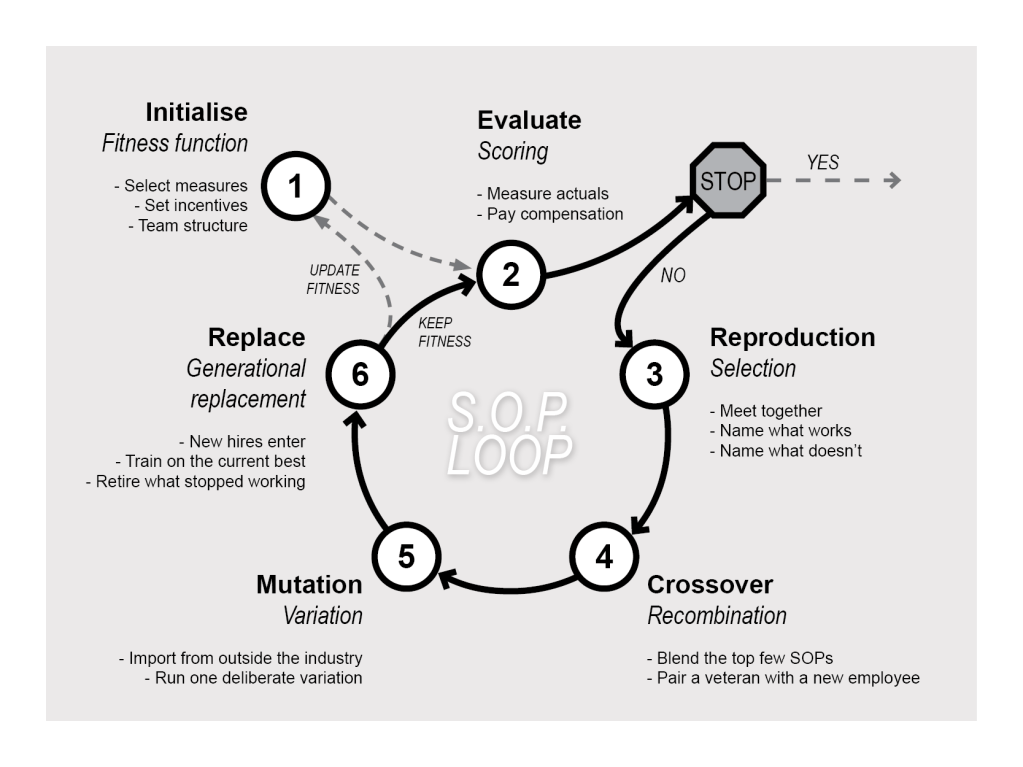
Leaders have a different role, defining system bounds and the fitness function. Not coming up with the solution. In fact, many GAs perform worse with more intervention. But defining a fitness that serves your outcome is the limitation I flagged earlier, and the thing most likely to go wrong. Which is exactly why the selection criteria have to be set centrally.
The recent progress of evolutionary AI leaves clues on where to add this in an organisation. In my small business, just being consistent in applying best practice gets you into the top 10%. But to differentiate and adapt, we need to explore new spaces. Not so much that all the previous value is forfeited, just a little searching on top of best practice.
Connections to my previous work
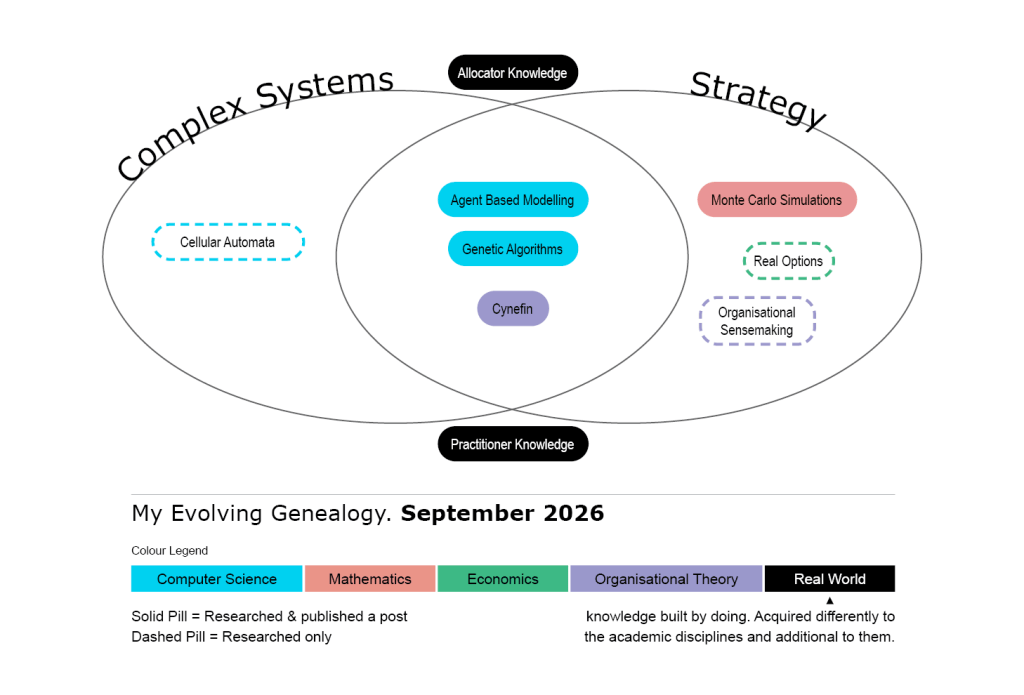
I’ve had The Origin of Species on my bookshelf for over 10 years. I’d just never thought to connect the book to algorithms. Now, as part of my ongoing journey to evolve and map my genealogy, I’ve placed GAs in the overlap of complex systems and strategy.
If I run GAs through the complexity checklist in my Are Organisations Complex? post, they tick nearly all of it. On the strategy side, I discovered GAs are practically a delivery method for the Cynefin complex approach: probe, sense, respond.
Although the academic use of GAs is in the computer science field, this step-by-step approach of Darwinian evolution allows a non-technical person like me to apply it within a business strategy context.
How my thoughts have evolved
Don’t overuse, but recombine.
Because this evolutionary method sounds like a natural law, it’s easy to justify applying anywhere. But like ShinkaEvolve, using it sparingly in combination with other exploratory methods saves energy and gets results. For business, its power lies in applying it thoroughly but imperfectly, somewhere between a rigorous experiment and a heuristic.

Explore & Exploit
A concept that has now clicked for me is “Explore and Exploit”. I’m seeing the idea everywhere in different versions now that I have become attuned to it. Explore is search, research, experimentation, randomness, mutation, divergence. Exploit is best practice, checklists, expertise, doubling-down, evidence, convergence. And there are two ways to think about it: vertically and horizontally. Vertically is stacking a small explore on top of your stable exploit, experimentation on top of best practice. Horizontally is through time, periods of exploiting what works in stable but competitive environments punctuated by exploration in times of disorder.
More Improvement, less Optimisation.
In Holland’s second edition of Adaptation in Natural and Artificial Systems, he stated his single biggest perspective shift after 15 years of reflection.
He said, “About the only change I would make would be to put more emphasis on improvement and less on optimization.”
He went on to explain this was because of the ever-evolving nature of complex systems. This is an important mental shift for me. It’s a call to focus on improvement in your context and relative advantage. Let go of chasing the perfect solution.
Now back to what to do about that 20% best practice can’t fix. I’ll think more about keeping part of the organisation exploring, and about increasing that share when my industry is disrupted. And I’ll add defining fitness to the leader’s job. One possible way this signal of fitness could get distributed throughout an organisation is through incentives (more on this in future posts). This moves leaders from the unrealistic solver of hard problems to the architect of the fitness function. Having the confidence to lead without an answer.


Leave a comment