What a flock of birds taught me about running a company.
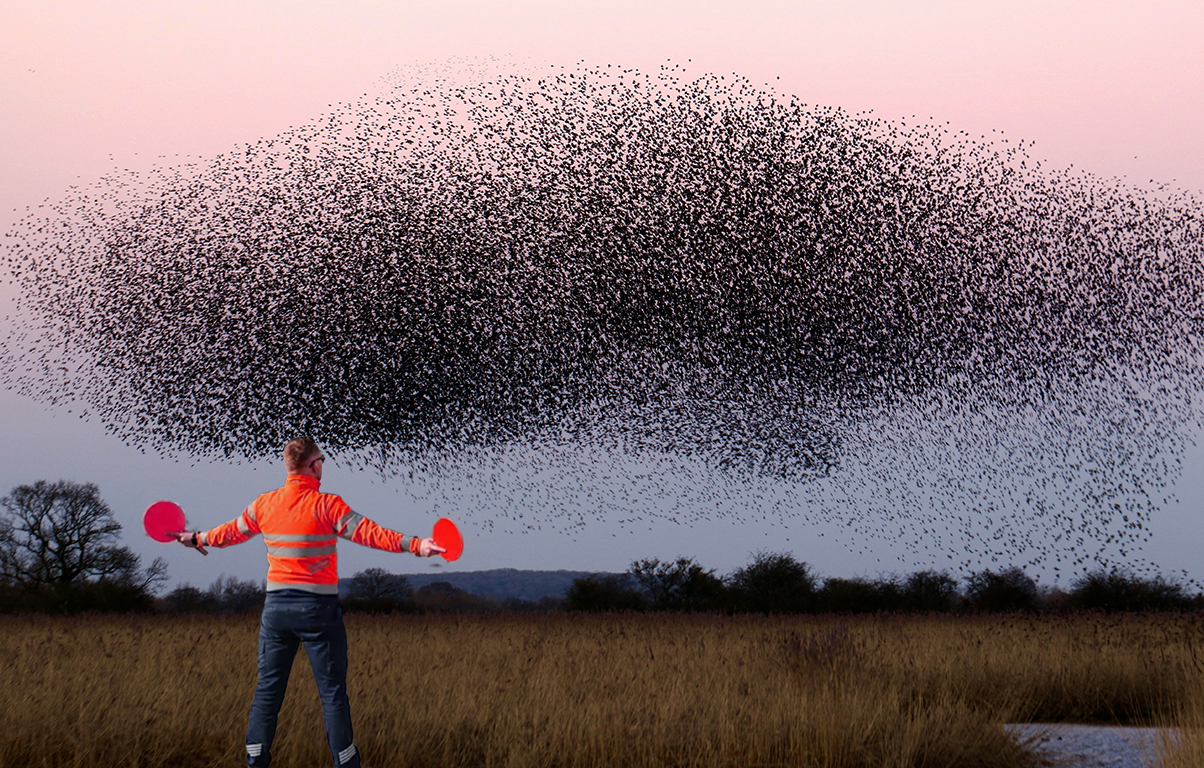
You’ve seen birds flock. They don’t just fly from A to B, it’s a dynamic swarm that is incredible to watch as they unknowingly change direction. But a flock has no leader and no explicit communication, and still thousands of birds move as one. Birds flock for survival and efficiency. How they do it is the part that caught me.
Researchers have found a few organising principles behind flocking. One is energetic, a physical structuring that saves the bird’s effort, another is topological (rather than physical distance). The third is the one that got me into complexity: a few local rules each bird follows are enough to reproduce the whole flock in a simple model, and those models have been around since the 1980s.
So let’s create a flock. Using a simple modelling system we can set up a population of agents, 300 birds here, scattered at random with a fixed maximum vision. Then each bird follows just 3 rules:
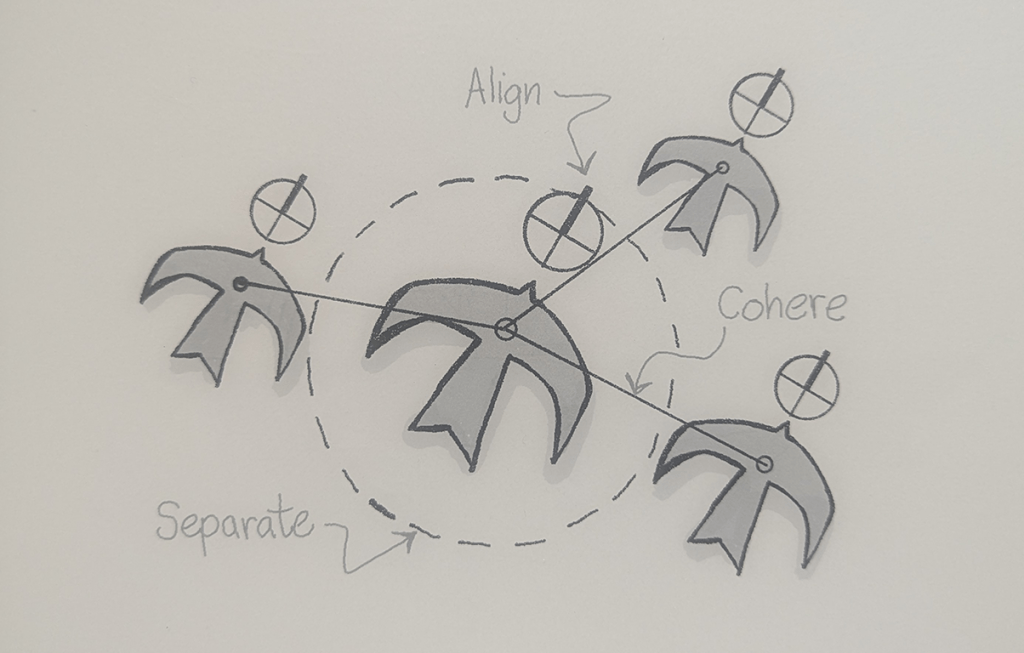
- Separate. Turn away from the nearest neighbour’s heading so I don’t crash, and keep a little distance.
- Align. Shift my heading toward the average of my neighbours.
- Cohere. Move toward my neighbours.
No path is programmed in, no strong-bird from above says “make a flock.” The flock is emergent. This model isn’t realistic, it’s a toy that makes the principles of emergence visible. It’s one example of a complex system, from the still-forming cross-disciplinary study called complexity science. Ant colonies, your nervous system, and the economy are others, and none of them reduce to deterministic rules
The interesting part is you don’t program a flock. You set the local rules and let the flock emerge.
From Flocks To Organisations.
A business of 300 people also has a mission. Usually survival first, growth second. Unlike a flock, it has a boss and a chain of command, but in my experience of running a service business, total centralised control is a delusion; organisations are not machines.
In a similar way, you can’t order the organisation to be successful from the top down. Take hiring a junior for sales prospecting. You can run every test and interview you want, and you still can’t predict one person’s performance much better than chance. That’s why I moved from deterministic to probabilistic thinking for that decision. It’s the flocking lesson again: you can only control so much from the top down, but if the individual agents align, they create something more than the sum of their parts. So strategy lives at the group level.
You set the local incentives and let the organisation’s success emerge.
Why it matters to me
As my business grew, I spent less time with customers, and I shifted from managing tasks to designing systems. I went looking through data for how to make better decisions and hit a fork. Do I use data to reach a single clean and positive answer, or do I use data to accept the messy uncertainty and still act? The temptation is to turn data into Disneyland because it feels nice.
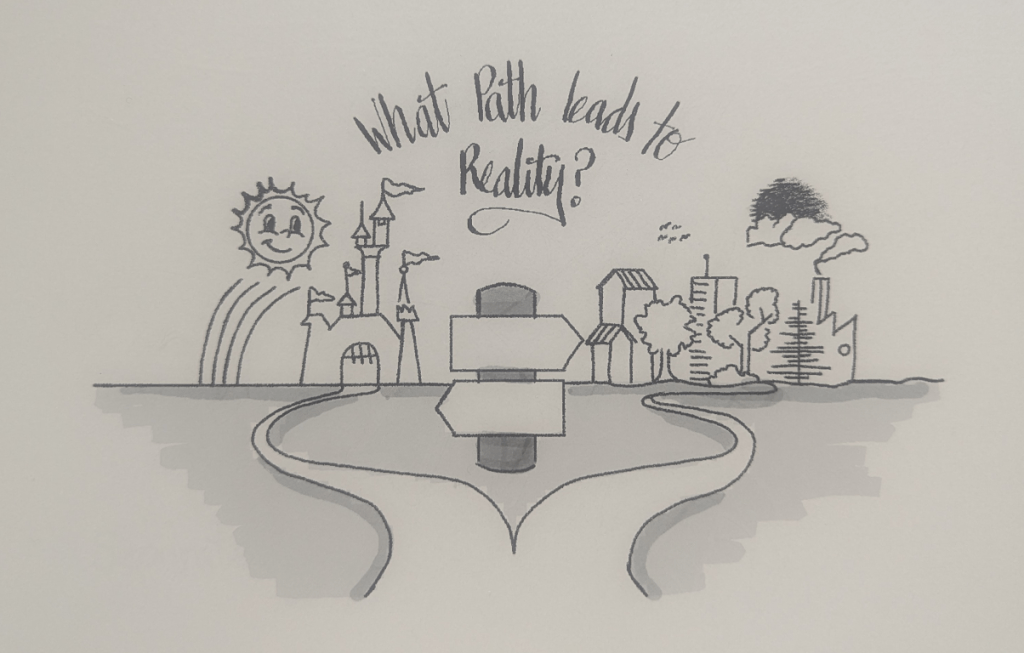
Decision-making under uncertainty led me to complexity, and it felt different from everything else I’d tried, it felt gritty and real. So in this post I’m picking a direction by asking the question directly: are organisations complex systems?
Defining My Terms: “Organisation”
Starting with the easier term first: What is a business organisation? Four experts answer it four ways.
Barnard, 1938, from a social angle: an organisation is consciously coordinated activity between two or more people, held together by shared purpose, willingness to cooperate, and communication. His question is why people stay in it.
Coase, 1937, from an economic angle: an organisation is what you get when coordinating work inside a firm costs less than coordinating it through the market. Its edge sits where internal coordination cost meets market transaction cost. His question is why the firm exists instead of everyone freelancing.
Katz and Kahn, 1966, from a systems angle: an organisation is an open system that takes inputs from its environment, transforms them, pushes outputs back out, and survives only by keeping that exchange running. Their question is how it stays alive.
Weick, 1979, from a process angle: organising is “a consensually validated grammar for reducing equivocality by means of sensible interlocked behaviours.”
In plainer words, people don’t run an organisation, they keep organising it, assembling interdependent actions into sequences that give everyone a shared, workable sense of what’s going on.
So the easy term isn’t that easy, but I’ll stop short of a full theory and say where I land. I like Weick’s version most, partly because it’s counter-intuitive and a little confusing on first read. He drops “organisation” as a noun and treats it as a verb. There’s no fixed thing to point at, only people interlocking their behaviour to make sense of ambiguity together.

Pulling the four together, an organisation from my understanding is:
- System: two or more agents inside a boundary.
- Connected: by coordination, cooperation, communication and interlocking behaviour.
- Interacting: with its environment.
- Transforming: inputs into outputs, done efficiently.
- Purposeful: a shared sense that the odds of survival are going up.
Now Defining “Complex Systems”
The word “complex” comes from the Latin root plectere, to weave or entwine.
There’s no simple answer here and no boundary the experts agree on, but I’ll try anyway. So what do the people who study complex systems actually say?
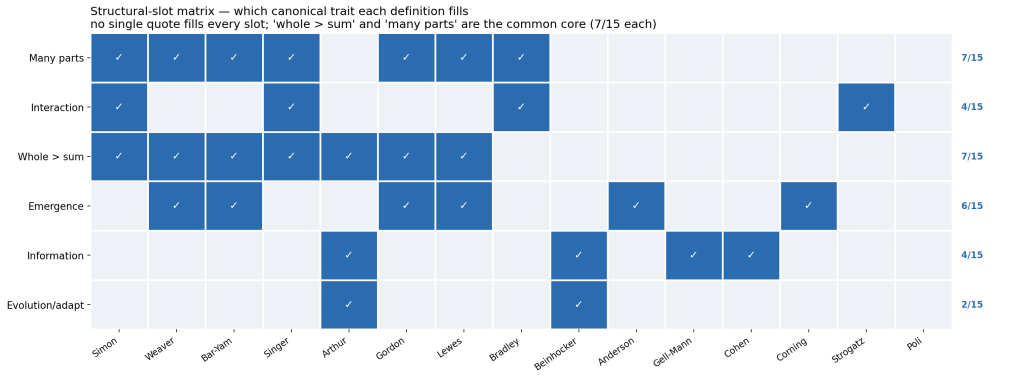

I took 15 expert definitions and looked at which words and phrases recur. At the phrase level they barely overlap, which fits Seth Lloyd’s line that there are many ways to measure complexity. 5 of the 15 definitions relied on negative reductive terms, showing the field is more aligned on what complexity is not. This has held true over 100 years.
Simon, 1962 – “not a trivial matter to infer the properties of the whole”
Bar-Yam, 1997 – “cannot be simply inferred from the behavior of its components”
Singer, 2010 – “cannot simply be derived from summation of individual components”
Lewes, 1879 – “cannot be reduced to their sum or their difference”
Arthur, 1999 – “not deterministic, predictable, and mechanistic…”
What they share is a set of separable traits, and each expert reaches for 2 or 3 of them from their home field:
- Many interacting parts
- Nonlinear interactions
- The whole can’t be reduced to the parts (emergence)
- Decentralised control
- Signalling and information processing
- Adaptation over time.
So my working definition:
A complex system has many parts that interact nonlinearly and adapt over time, with no central control. They signal and process information, and from these local interactions a whole emerges that cannot be reduced to its parts.
Playing Devil’s Advocate
The scientific community critique
Complexity science isn’t without its detractors. As an emerging field, it is yet to hold the esteem and credibility of others like physics. The lack of mathematical rigour, universal laws and predictive power has led some to label it as “pop science” or “smoke and mirrors”.
Complexity science leans on computer modelling, simplified ideal models and incomplete data. To some, its vague terms and thin rigour resemble its predecessor, cybernetics, which after great initial hype in the mid-century, failed to establish theoretical foundations and has made little progress since. Complexity science hasn’t been disproven, and many scientists are excited by it. Time will tell whether it builds the foundations to survive the critique.
A flock has no leader, but an organisation has a CEO?
A key element of complexity I mentioned above was decentralised control. In organisations this is obviously not the case, and that matters for answering my question. The reason complex systems rely on decentralised control is the limit of what a central hierarchy can control. Yaneer Bar-Yam explains this in his book Dynamics of Complex Systems.

“The essential point is that the nature of a hierarchically controlled system requires that the behavioral complexity of the controlled group is smaller than the controlling individual. Thus, a hierarchical system implies a limit to the complexity of the collective behavior on whatever scale and in whatever aspect the control is exercised”.
In short, a controlled group can’t behave more complexly than the person controlling it. As a firm grows beyond that ceiling, it makes total control impossible.
This doesn’t void an individual’s influence on the system, or greater control on a specific level within the system. I believe it does disprove the idea that the boss can have total control over a large organisation. To qualify as a complex system, decentralised control of the whole is a requirement, but centralised control can still exist within a section of the system. This concept is called “Functional Segregation”. An obvious example of this is the whole economy being a decentralised system, while having a centrally controlled Federal Reserve that can have great influence over it.
The Map Is Not The Territory
I love building models of systems, I think it’s a Lego thing from childhood. But when I start believing my own toys are real, I repeat a line to myself: “the map is not the territory,” from Alfred Korzybski in 1931. Every model is a simplification of the real thing and complexity science has shown that tiny differences in starting conditions can produce wildly different outcomes. If I can never know all the starting conditions, and I’m forced to simplify, then what’s the point of a model at all?
There’s a second quote for that. “All models are wrong, but some are useful,” from the statistician George Box in 1976. A model earns its place not by predicting perfectly but by exposing general principles of how a system behaves. What you do with those principles is a separate question.
Diminishing Returns & Heuristics
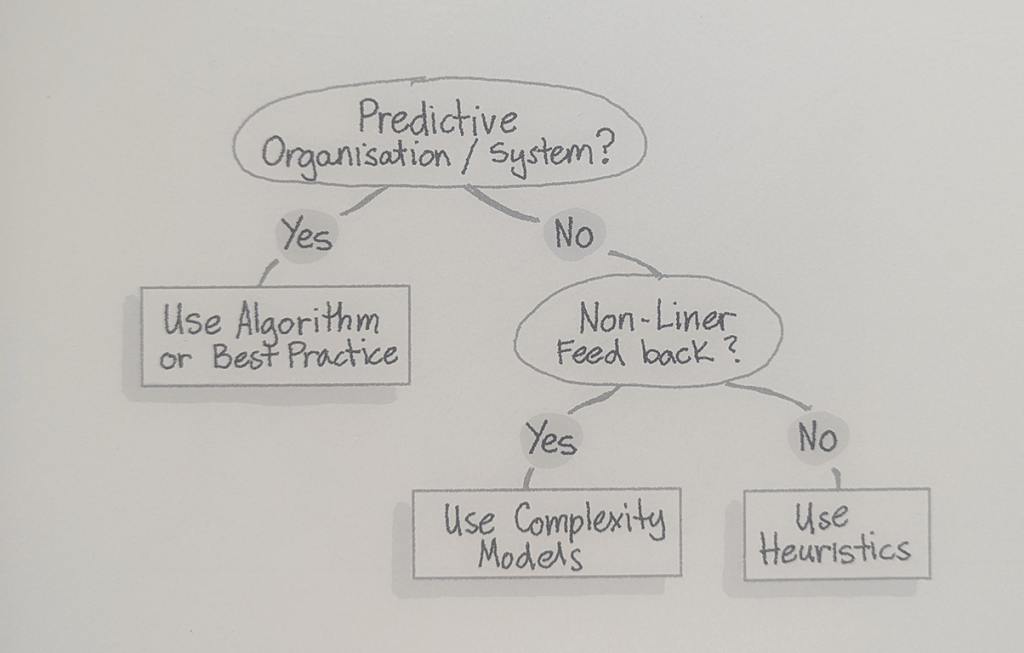
There are diminishing returns to going deeper on the technical machinery if the solution cannot be perfectly predicted. The value of complexity is in matching the tool to the level, then taking the right lesson from it.
Take Cynefin, a sense-making model that maps your situation onto a framework and tells you which kind of approach fits. It’s useful because it’s a simple map and it only asks that you understand the conceptual idea. The downside is it won’t hand you the solution or a precise prediction, it has limits.
The effort a tool costs has to be smaller than the productivity it returns, or there’s no reason to use it. This is where folk knowledge, or heuristics, punches above its weight. Even now, with AI and cheap computation, a simple rule of thumb can beat a complex algorithm in an uncertain real-world setting.
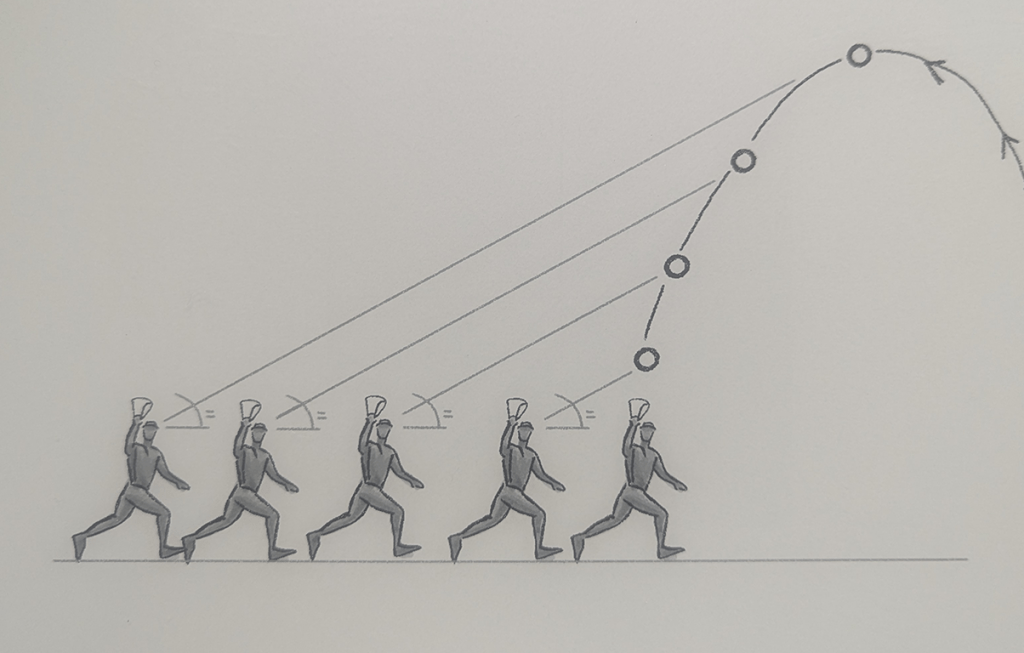
The gaze heuristic is a good one. A fielder catching a fly ball doesn’t use physics. They fix their eyes on the ball, run, and adjust their speed so the angle of their gaze stays constant. The catch takes care of itself without explicit calculation. But heuristics aren’t equally good everywhere; they fade when uncertainty is low and information is high. More to the point for this post, they struggle with systems full of compounding variables and feedback loops.
Connecting Complexity to My Professional Focus
Complexity isn’t a single node in my study; it’s a field with many points inside it. For my work on decision support in organisations, the useful boundaries inside complexity, and the overlaps with neighbouring fields like strategy and visual models, will show up over time as I write. This post plants the root for myself; the specific nodes will hang off it later.

Grounding the Answer.
Levels of abstraction
Complexity science doesn’t belong in every task in a business. Some work should be best practice, some are legal or contractual requirements, some just need a fast, frugal rule of thumb for a quick finish.
The further I’ve moved from the client, the longer the timelines, the bigger team, the more complexity thinking has mattered. Without naming it at the time, I was climbing to a different level of abstraction. Moving up abstraction levels can help you see more and access more, but you lose nuance as simplification is a must.
Dynamics in a business
A business is dynamic, every day you do a little, and it compounds over time. When a business is small and simple the possibilities are limited. But as complexity grows, more people, more products, a shifting market, the cone of uncertainty widens toward chaos, and the number of possible end states climbs.

I’d add a third axis to this: alignment to purpose. Put the three together and uncertainty isn’t automatically bad, as long as the odds of survival are going up. Because there’s a real cost to intervening in a system. Keeping a system organised requires energy, and that cost isn’t free. If you want to go deep into that, look up Maxwell’s demon, but that’s a thread for another post.
My Verdict.

So, are organisations complex?
The complex-system traits and the organisation traits aren’t a perfect match, but five of the six line up. Traditional business decision-making has taken us far, yet as organisational complexity grows, that old level of control starts to constrain you. A five-year plan that once worked can hold a business back today.
Inverting the question makes it clearer. Are organisations simple, reductionist, and mechanistic? I think not. Some sit closer to that end than others. The business world spends heavily on managers, consultants, and analysts to get more grip on their organisations. That spend doesn’t prove anyone has the answer, it proves the problem of uncertainty and lost control is real.
So here’s my answer. For the right problems, at the right level of abstraction, at the right size, I think yes, organisations are complex systems. This is where the flock comes back. You can’t order 300 birds into formation, and you can’t order 300 people into a great company. You can’t predict one bird, or one new hire. What you can do is set the local rules, the incentives and the information each part acts on, and let the shape emerge. The boss isn’t the exception to this. A firm has a CEO, but centralised control has a ceiling, so the leader’s job is to set the conditions at the edges while the flock does the flying.
I’m not claiming these tools fit every decision in a business. I find them fascinating precisely because they’re counterintuitive and underused.
I’m not sure you can herd a flock of wild birds? (it’s a funny thought). So of course I looked into it, and airports and golf courses have exactly this problem. They throw falcons, noise and lasers at the problem. They can move a flock, but they never get to steer it. Somehow that metaphor feels more true than picturing an organisation as a clock. In a manager’s dream they wind an organisation up and watch it keep perfect time. But in reality you set the conditions, let the flock do the flying, then adapt.
That’s the ground I want to work on, reading the flock and getting better at setting the conditions it responds to. For me that’s strategic decision support in organisations.

Leave a Reply