My failing café, sandwich simulations & a reinforcing loop that explains why caution is the riskiest growth strategy.

In the late 2010s, with little experience and a lot of naive confidence, I opened a new cafe in a Western Sydney corporate park. After signing a long lease, borrowing a lot of money and my wife being due with our second child, I opened the doors to the new business. From day one the cafe was well-received—I was featured in the local paper and on a TV segment. People complimented how much they loved the place. This positive reception made me furious. In reality, the business was failing financially with low turnover, and compliments didn’t help me identify the cause.
Desperate to turn it around, I reached out to anyone I knew with experience for advice. Con was a cafe broker, with a blunt Greek confidence, his assessment of my situation was devastatingly straightforward. “Close the door, hand back the key and take the loss.” Based on my current numbers, my business was worthless. It was a hard pill to swallow… I did accept his current valuation but I refused to believe the business could not be saved. I was selling sandwiches to workers. This wasn’t rocket science; there must be a solution.
A particular breakthrough came from Sam, who I had met a few years back when doing some design work for his shop. With multi-generation experience in hospitality, Sam had an intuitive feel from growing up around shops. He immediately saw what I was missing. Looking at my display, Sam asked “How many sandwiches do you need to sell a day to hit your numbers?”, when I replied about a hundred, he pointed out that I had only made thirty today. I explained how I have consistently been selling fifteen a day and because I was losing money, I didn’t want more wastage.
Sam looked at me and said, “Stack the sandwiches high. Make a hundred every day until you sell a hundred”.
My first thought was, ‘Great, now I can lose money even faster!’ But Sam’s simple heuristic held a wisdom that felt different, so with the conviction of a true believer I immediately adopted the strategy, stacking the sandwiches high day in and day out, and slowly but surely, sales began to rise.
Looking under the hood.
Sam’s advice worked. But for years after it nagged at me because it sounded like law-of attraction stuff. I wanted to know: was this superstition or science? Was my story survivorship bias dressed up as a motivational hack, or was there an underlying mechanism?
Years later, while running a real estate business, I found myself telling this story to a sales agent trying to grow his market share in a competitive suburb. Selling sandwiches or selling houses — the mechanics felt the same. I wanted to know how.
So I built two simulations to find out. In one simulation was my cautious approach, the other Sam’s more aggressive approach of coming out of the gates strong from opening day. The marketplace would have five competing shops, five hundred potential customers each following some simple rules:
- If a shop sells out one day, they make more the next day. If they don’t sell out, they make a little less.
- Customers are more likely to come back if they get what they want. They are more likely to switch if they are disappointed.
- People tend to eat lunch where their friends eat lunch.
- People tell their friends about good experiences.
- If a shop is very popular, people that don’t usually buy will check it out.
For a more detailed explanation see the Extra Reading: The Model Setup section at the end.
No master plan from the shop owners, no average customer, just individual people bumping into each other making local decisions. I then ran this for 365 days to see what would emerge. This type of model is called an Agent-based Model (ABM). Instead of predicting from the top down, you set simple rules at the individual level and watch the patterns emerge from the bottom up. Traffic jams on freeways work the same way: every driver (or agent) just brakes when someone’s close and accelerates when no one’s ahead, yet phantom jams appear with no accident in sight because of delays in the feedback loop.
Running two ABM sandwich simulations.
The aggressive and cautious simulations are side-by-side with each frame representing one day within a year. Watch the red cell (shop A) to see the difference in how its market share changes over time in the different simulations by responding to local events.
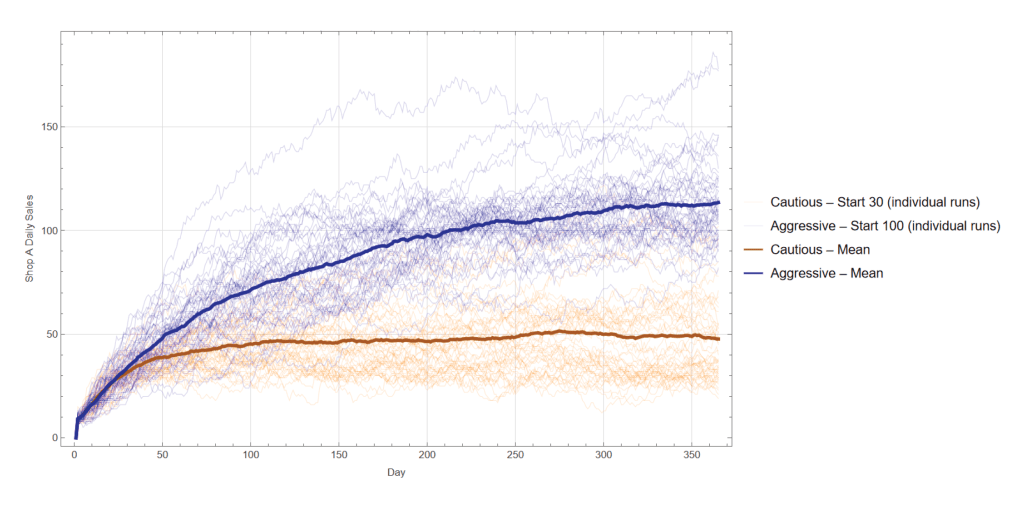
The line plot compares Shop A’s sales over 365 days for the two methods. The key difference isn’t the upside, it’s the floor. The 100-sandwich minimum acts as a structural safety net, catching every dip before it compounds. Without that floor, the cautious strategy lets negative runs reinforce themselves until sales spiral.

This line plot represents a single scenario based on a particular set of initial conditions. A more thorough way to stress test this theory is a Monte Carlo analysis of the model, testing slight variations of initial conditions to showcase the distribution of possibilities in the setup. By running fifty variations of the experiment we can clearly plot the mean result for both approaches, and the winner becomes clear.
The mechanics of growth.
A Lesson in Reinforcing Loops – Start the momentum, aka, Stack them high!
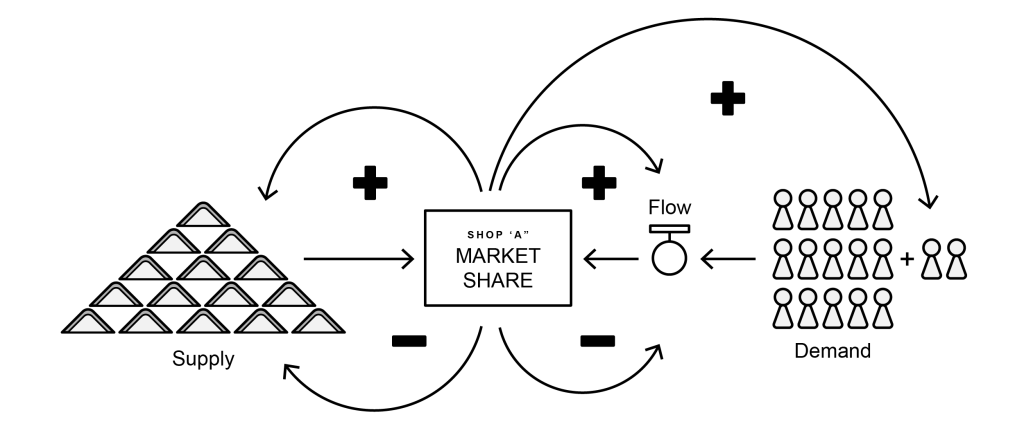
I was waiting for people to buy more sandwiches, then I would make more, but that’s not how growth works. In this system, there are multiple Reinforcing Loops. The cautious strategy stalled this loop by waiting for customer demand to rise before increasing supply, trapping the system at a low equilibrium. The aggressive approach injected ‘energy’ to force supply high, kickstarting the compounding momentum by increasing supply flow to achieve sustained sales growth.
Three things determine whether that loop accelerates or stalls:
The first is conditioning. If a customer shows up and gets fed, they come back. If they show up and you’re sold out, you’ve just trained them to go elsewhere. Psychologists call this operant conditioning, behaviour shaped by reward and punishment. My cafe was a Skinner Box, and I was accidentally punishing my best customers whenever I sold out. Every empty shelf was a lesson: don’t come back.

The second is peer influence. People don’t choose lunch spots in isolation. If five of your colleagues walk to one cafe, you’re going too. You didn’t compare menus, you followed the group. In sociology this is called the voter model: decisions spreading through local peer influence rather than individual rational choice. One loyal customer isn’t one sale, they’re an influential “agent” on the board, pulling their neighbours toward you.
The third is system delays. My results today weren’t caused by what I did today, they were a rough average of the last few months plus noise. I kept reacting to daily sales like they were clear signals, when most of it was just the system being noisy. Systems have ‘lags’, the solution is to rely on long-term trends which act to smooth out daily unpredictability. Exactly what Sam’s “stack them high every day” forced me to do.
Asking the right questions
Sam didn’t give me a strategy. He asked me a question and pointed at my shelf. The answer was already there — I just couldn’t see it because I was immersed inside it.
Inside a system where growth depends on compounding local interactions, these are the questions I’d now ask myself:
- Am I basing supply on current demand instead of target demand? The cautious instinct is to match what you’re selling today. The lesson is that supply isn’t a response to demand — it’s a signal that creates it.
- Am I accidentally training my customers to go elsewhere? Every time someone encounters your empty shelf, closed shop, or full calendar, that’s a conditioning event. What does a customer experience when they show up at an unexpected time?
- Am I reacting to daily noise or tracking the compounding trend? If you’re changing your strategy based on what happened yesterday, you’re chasing system noise. The question is whether your trailing average is moving, not whether Tuesday was bad.
- How many of my customers are pulling others toward me? One loyal customer in a tight network is worth more than ten isolated ones. Where can you build clusters of fans?
The point of this model was not to predict sandwich numbers, it was to test whether Sam’s instinct had a mechanism behind it. It did.
When a reinforcing loop is trapped at a low equilibrium, cautious incrementalism doesn’t free it — it maintains. The only way out is deliberate energy injection to shift the system into a new attractor state. After that, the system does the heavy lifting.
Extra Reading: The Model Setup.
Agent-based modeling: A powerful simulation technique where macro-level patterns, or ‘emergence,’ arise naturally from simple, local rules defined for individual ‘agents’ (customers). This approach better reflects real-world systems, which are driven by diverse individuals influencing each other through dynamic feedback loops, unlike models based on a single ‘average’ customer.
The Setup: The model simulates a local market using a 20×25 grid, representing 500 potential daily customers (cells) over a period of 365 days.
The Agents: The cells represent consumers who can be in different states: inactive (latent), or customers of one of five shops (Shop A, the new entrant, and competitors B, C, D and E)
The Start: On Day 1, 300 agents are active and equally divided among competitors. On Day 2, Shop A opens, capturing 2.5% of the active agents who represent the “innovators”.
The Parameters:
- Supply Dynamics: This rule simulates the local lag in responding to demand. Shop owners try to match tomorrow’s demand from the most current information available to them.
- If a shop sells out, it increases supply by +5 for the next day.
- If a shop has leftovers (waste), it reduces supply by -2 for the next day.
- The Skinner Box: This rule simulates operant conditioning theory based on customers getting fed. Simply, it’s behaviour training where based on the interaction there is either a reward or punishment.
- Success: If demand is met (customer gets a sandwich), the customer becomes “loyal”—they buy again the next day and become resistant to Word-of-Mouth.
- Failure: If demand is not met (shop sold out), the customer becomes susceptible to local influence and may switch shops.
- Peer Pressure/Voter Model: If all 8 of a cell’s neighbours buy from a single shop, the center cell automatically converts to that shop. Translation: If all your friends are going, you go too.
- Word-of-mouth: If a customer is happy (demand met), their 4 touching neighbours have a 10% chance of converting to that shop. Conversely, unmet demand creates a 10% chance for neighbours to switch away. This simulates the effect of gossip.
- Going Viral: If a single shop captures more than 50% of the active market, it “goes viral,” converting 10% of the previously inactive (latent) cells. This activates those “laggards” (change theory) that need social proof before trying new things.
Model Assumptions: As with any model, it oversimplifies and drastically reduces the complexity of reality, no matter how detailed. Some oversimplifications made in this model are: all shop elements (food, service, price) are assumed to be of equal value, the total market is constant, your competition does not change or evolve and it does not account for profit. These are just some but there would be many more.

Leave a Reply