Stop letting the ‘Hire Slow, Fire Fast’ mantra stunt your growth like I did. Bin the crystal ball and shift to parallel hiring for emotional work.

The best business development manager (BDM) we had in years wanted to leave his role to try out sales. He performed well, wanted to stay with the business and was happy to transition over a few months—the dream scenario for staff change. Finding a suitable replacement however, proved difficult.
I hired a few people who didn’t work out. After a few mismatches I dug my heels in; I interviewed more, upped the pay, slowed the processes down to better identify the right person for the job. The result was no better. I realised there was something unique about this type of role. It just wasn’t about skill, the job involved a high amount of rejection, mostly outbound tasks and delayed gratification. The job was emotional work more than anything else.
It had taken years to come across the first high performing person, why should I get one in months? It became clear that when you are hiring for a role with high levels of emotional work that you need a different hiring approach and this approach requires a different organizational structure and strategy.
For our organisation, the structural move was to merge the leasing consultants, a junior-level role, with the BDM position to create a united team. This is an unconventional approach in real estate businesses, seen as inefficient and slow. I believe this is because some were optimising for the wrong problem. Doing this actually led to everyone having greater support and a better career trajectory, whilst I had my reserve grade of talent.
If your job type involves highly-emotional work like mine did, being detailed and slow in your hiring process seems like a rational thing to do, and that’s the problem. The ‘Hire Slow, Fire Fast’ mantra is best practice recruitment. However, for emotional roles, this leads to your success being stunted.
Emotional work would include any type of sales, customer feedback, some creatives, and particular healthcare jobs. Hiring processes are largely built around mechanical and intellectual capabilities, and while those components are important for these types of roles, they are ultimately secondary.
My outcome was not a better BDM, it was a greater choice of talent and a more effective organizational structure for growth. I now had the option of scaling past one successful individual towards a team of successful people, as I owned the skill of talent identification.
In trying hard to look at the situation from a fresh perspective, I asked myself, What is different about this role that makes me unable to predict success with higher certainty? Could I change my approach to hiring? What is stopping me from approaching it differently, am I scared of something? (My own emotional work!)
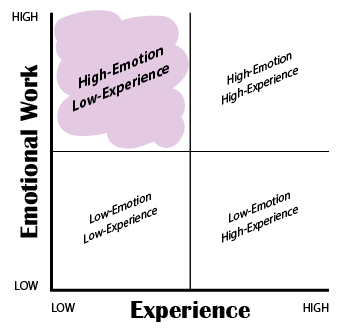
The Emotional & Experience 2×2.
Every role has specific attributes that define it. This was an opportunity that requires outbound calls to hundreds of potential clients a week, where a very small success rate is typical. Knowing this prior to sitting down and doing a call session can be mentally tough. It was highly-emotional work.
The emotion required needs to be that person’s “thing”, I see it as similar to doing an ice plunge. Like every person on the planet today I had heard the benefits of doing regular ice plunges, I read some of the science, watched Wim Hof videos, and listened to my friends repeat what Joe Rogan said. Intrigued enough I decided to give it a go. Now I’m glad I tried it, it wasn’t that horrible. I still believe it has health benefits, but I will not be doing it again. I just don’t want to do it, it’s not my thing.
Similar to an ice plunge, these are low yielding tasks. Delayed gratification is built into them. The key to succeeding in these tasks is a predisposition (maybe at the personality level) to perseverance or lack of discouragement for the sparsely rewarded task. This makes identifying successful applicants through the traditional interview process functionally impossible.
This 2×2 framework plots a role’s emotional requirement against the level of prior experience.
My initial reaction to understanding this was to try to communicate better. In job interviews I tried to be more transparent about the difficulties of outbound prospecting, and most people said they understood and are willing to do what it takes, not only that, they say they will enjoy it. Seeing multiple times this was not the case only six months later, and being convinced the person was being 100% honest at the time, I realised I was the problem for asking the question, ‘Are you happy to do prospecting long term?’. With low experience and in a job interview, what answer other than ‘definitely!’ would an intelligent person say. It was like asking my 7 year old daughter to pick her future career and lock it in today, then being disappointed 15 years later when she decided not to be a ‘cupcake baker’ who starts work at 3am everyday.
Shifting the Decision Point.
My insight was that the predictability of future performance in high-emotion, low-experience roles is low at the point of hiring, and additional information or time do not increase the odds dramatically. But if I thought back to my experience, what was a complex decision at the interview stage became crystal clear months later with time in the role. This maps nicely to the Cynefin way of thinking.
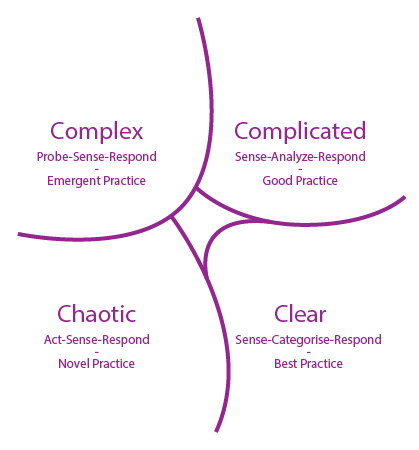
A quick intro, Cynefin is a sense-making tool that categorizes decisions into five domains. The idea is that different decision domains require different responses. As uncertainty is added, a simple approach (like a recipe) can fail as the complexity shifts.
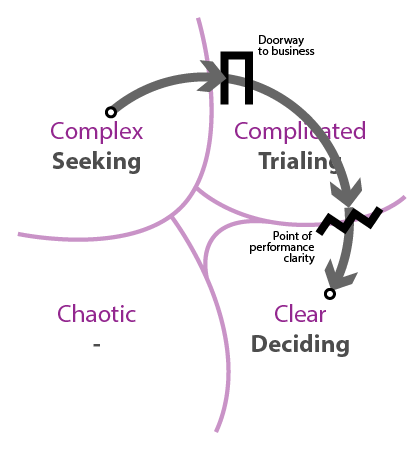
I realised that for this type of role, deciding who to hire was initially complex and functionally impossible. Over time and seeing them work, it eventually became a simple decision amenable to best practices. The hiring timeline can be split up into three distinct stages that map to the decision domains.
Predicting Future Performance:
- Seeking, or recruiting stage = Complex
- Training, or probation period = Complicated
- Deciding, evaluating evidence after practice = Clear
With this mapped out, why am I forcing myself to make long term decisions in the complex seeking stage? It’s hard and I’m likely to fail, why not wait until it’s clear? My new approach would need to be both attractive to talent and well funded.
Funding the Shift.
If the funding strategy made sense I could keep this system going over time.
In my case I had a few people in a junior leasing role. It was a good introduction into the world of residential property management, but what it did not do is uncover the type of work they excelled in, especially highly-emotional work. Traditionally they would have to wait until they changed roles to find that out.
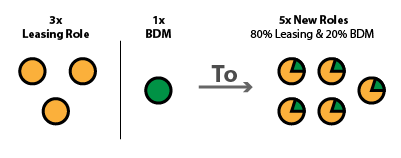
Through maintaining most of their current tasks and allocating up to 20% of their time to high-emotion tasks we could find out the answer to whether highly-emotional work was their thing. This took away the guess work and urgency to decide in a complex domain.
Rather than hiring a bunch of people to do just prospecting knowing most of them would not work out, we emulated hiring people part time. This was the equivalent of a trial period but where they remained 80% employed in a clearly value generating role.
Parallel vs Sequential Hiring.
Let’s call hiring slow for an individual role “sequential hiring”. What tends to happen in this approach is you hire slowly by investing time and energy in seeking the correct match, then follow up by investing a lot of time into training that person, but instead of firing fast when there is not a match in the decision period, you look back at the total time plus emotion plus money plus training invested and become hesitant to forfeit what you have already spent.
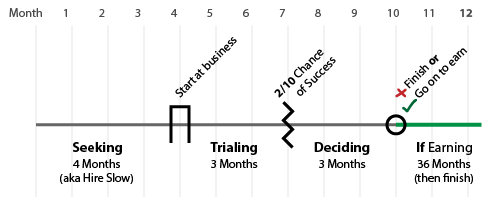
This is the sunk cost fallacy, a well researched cognitive bias where a person is reluctant to abandon what they have already invested even when it cannot be recovered, and continues to invest in the face of evidence that may be against their best interest. This is no problem if the match rate is high, but when it’s low you need another approach. The useful, and (mostly) correct notion behind ‘hire slow, fire fast’ is that hiring slow significantly increases your odds of hiring the right person. However, for emotional roles, hiring slow doesn’t de-risk the hire, it just increases the amount of time and money you spend on hiring without learning anything about the most important trait that will help them succeed or fail.
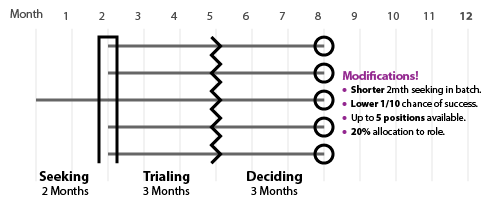
“Parallel hiring” on the other hand, looks to accept the low odds, make more bets and categorise the observed performance before responding. Instead of betting in a linear sequence on one person with low odds, we shift to investing a small amount over many people and wait. This seems obvious, but to execute you would be accepting much larger upfront costs, hence why the funding strategy is the key to making this work.
Even with the chance of success being lower, (as per the model) you can achieve better results with parallel hiring!
The Dynamics of Time with Parallel & Sequential Hiring.
With the sequential approach the initial investment is minimal, you have quick visible returns but over the course of years those unpredictable events and slower recovery will accumulate losses or low returns. With the parallel approach there is a heavy upfront cost, this looks bad, but the greater earning time, fast recovery and success will accumulate. For managers, it takes guts to stick to this strategy, that is why most don’t do it. You will see more failures. It will cost you more initially, but those mismatches were always on your future path, by bringing them forward they don’t change the individual person’s odds. Below I have created a simple model to visualise the two approaches.
Sequential hire approach over 20 years.
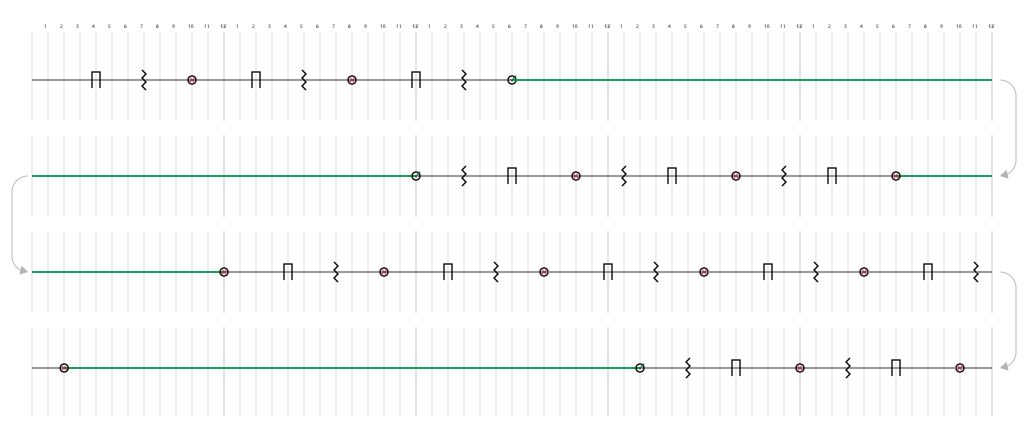
Parallel hire approach over 20 years.
Am I saying to just hire anyone and see what happens? No, I’m not. I’m suggesting sticking to reasonable hiring practices, but don’t ask from it something that it can’t deliver (high predictability for emotional work). The hiring investment needs to be limited in time and money, so hire in batches efficiently, not carelessly.
The Results.
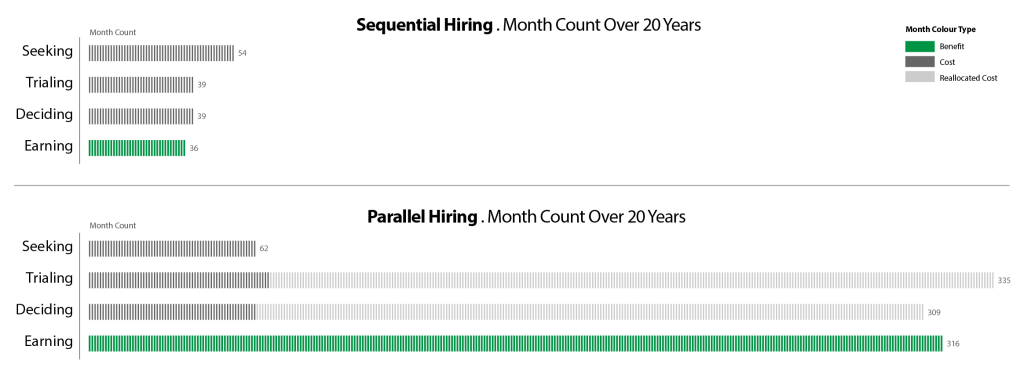
Using a simplistic model to evaluate the approach, the outcomes are represented side-by-side in month counts. With sequential hiring, the time dedicated to “hiring slow,” combined with the low match rate, severely limits the time spent earning, resulting in low performance.
Parallel hiring demonstrates a huge upside, yielding more than 8X the earning months.
Although the parallel strategy generates significantly more activity (both cost and benefit), by allocating only 20% of time to these stages (and reallocating the remaining 80% to existing tasks), we can mitigate the downside while maximizing the upside. It’s noteworthy that in the model, sequential hiring has a 2 in 10 probability of a good match where parallel has only a 1 in 10, yet parallel still substantially outperforms in earnings.
The traditional “Hire Slow, Fire Fast” model fails for roles heavy in emotional work (high rejection, delayed gratification). The standard of sequential hiring forces premature decisions in the unpredictable seeking stage, leading to the sunk cost fallacy and poor upside.
The solution is Parallel Hiring with robust funding. This involves making multiple small bets concurrently, early integration of junior roles into high-emotion tasks. This shifts the decision point from prediction to observation, allowing real-world evidence to tell you if it’s this person’s “thing”.
While Parallel Hiring requires greater upfront cost and accepts more observed mismatches, it accelerates time-to-success and is an investment into scalable talent identification. I learnt to tolerate short-term costs and visible failures in exchange for fostering long-term growth by creating an environment where I don’t need a crystal ball, instead I fund, observe, categorize, reward and repeat.
Action Steps
- Where does this job role sit on the 2×2?
- If top left proceed to “Hire in Parallel”. If not, “Hire Slow”.
- Get the funding requirements and strategy signed off.
- Shorten the seeking and deciding period as much as possible.
- Balance the opportunity for all hires and get clear about the essential KPI’s.
- Observe without prediction, then promote when you find a match.
- Repeat when a spot opens up.

Leave a Reply